
There are seasons in life when you do not feel like the old version of yourself anymore.
Not exactly broken or brand new.
Just somewhere in the middle…
You may be coming out of burnout.
- A friendship may have changed.
- A relationship may have ended.
- A dream may have shifted.
Maybe you spent a long time saying yes when your whole body was asking you to say no.
Maybe you ignored your own needs so often that now, when someone asks what you want, your mind goes blank.
That is the rebuilding season.
It is the quiet place after the storm, the messy middle after the ending, the tender chapter where you are trying to become steady again.
And in that place, one of the hardest things to rebuild is not your schedule, your confidence, your routine, or even your motivation.
It is self-trust.
Self-trust is the feeling that says, “I can listen to myself.”
It says, “My needs matter.”
It says, “I may not know everything, but I can take the next honest step.”
It says, “Even if I make a mistake, I will not abandon myself.”
That kind of trust is not built overnight.
It is not something you can force with a motivational quote or a perfect morning routine.
Self-trust grows through small moments of returning to yourself…
- One honest answer.
- One boundary.
- One decision you do not outsource.
- One promise you actually keep.
That is where these self trust journal prompts come in.
Journaling gives your inner voice a place to speak without interruption...
- It does not have to be beautiful.
- It does not have to sound wise.
- It does not even have to make sense at first.
Experts often describe journaling as a flexible, personal practice rather than something with strict rules, and that matters because self-trust does not grow well under pressure. (theguardian.com)
This article is not here to rush your healing.
It is not here to tell you to “just believe in yourself” as if doubt disappears on command.
Instead, think of it as a soft place to begin again.
Below, you will find 30 self trust journal prompts created specifically for the rebuilding season: the season where you are learning to hear yourself again, forgive yourself again, choose yourself again, and become someone you can rely on.
What Self-Trust Really Means During a Rebuilding Season
Self-trust is often misunderstood.
People sometimes think trusting yourself means you are always confident, always certain, always brave, and always making the “right” decision.
But that is not self-trust.
That is perfection wearing a confidence costume.
Real self-trust is much more human than that.
Self-trust means you believe you can handle your own life with honesty and care.
It means you are willing to listen to yourself before immediately asking everyone else what they think.
It means you can make a decision, learn from the outcome, and stay kind to yourself in the process.
During a rebuilding season, self-trust can feel fragile because you may be carrying evidence from the past.
- Maybe you trusted someone who disappointed you.
- Maybe you trusted a plan that fell apart.
- Maybe you trusted your own decision and it did not lead where you hoped.
- Maybe you ignored red flags, overgave, stayed too long, left too late, said yes too many times, or talked yourself out of what you knew.
So now, when your inner voice whispers, you question it.
“Are you sure?”
“What if I am wrong again?”
“What if I mess this up?”
“What if I cannot trust what I feel?”
That is painful, but it is also understandable.
Your mind may be trying to protect you from repeating old hurt.
But protection can become a cage when it keeps you from making any choice at all.
This is why rebuilding self-trust is not about shaming yourself for doubting.
It is about creating new evidence...
- You rebuild self-trust when you pause before saying yes.
- You rebuild it when you admit what you actually feel.
- You rebuild it when you stop explaining away your discomfort.
- You rebuild it when you keep a small promise to yourself.
- You rebuild it when you make one decision from your values instead of your fear.
The rebuilding season is not asking you to become fearless.
It is asking you to become honest.
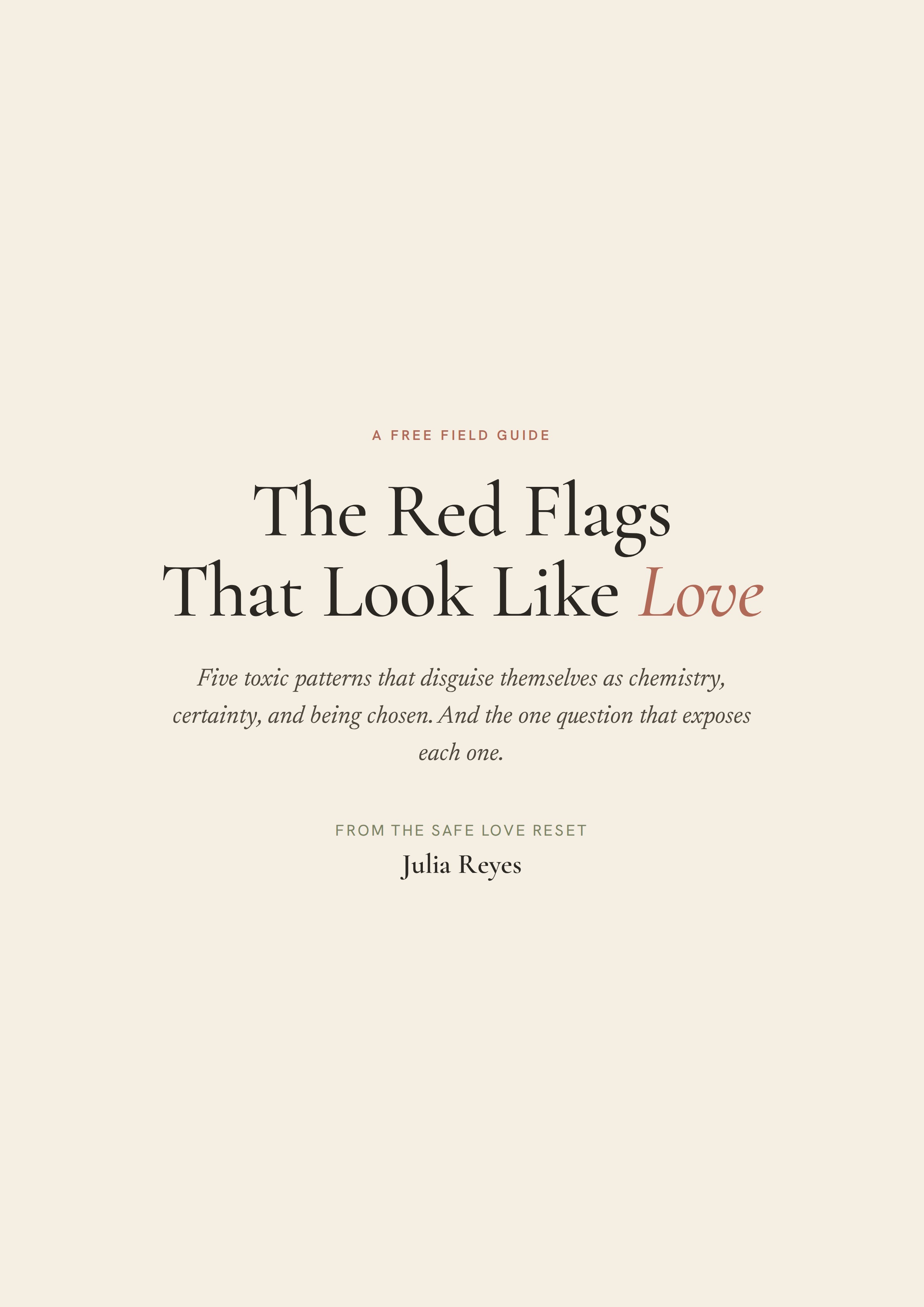
The Red Flags That Look Like Love
Get the free checklist of the toxic patterns that disguise themselves as chemistry, certainty, and being chosen, with the one question that exposes each one.
Straight to your inbox, along with The Safe Love Reset every Monday. No spam, no shaming, leave anytime.
How to Use These Self Trust Journal Prompts
Before you jump into the prompts, let’s take the pressure off.
You do not need to answer all 30 in one sitting.
Actually, please do not turn this into another assignment you have to “perform” perfectly.
Self-trust cannot grow in the same soil as self-punishment...
- Choose one prompt that pulls at you.
- Write for five minutes.
- Stop when you feel complete.
- Your answers can be messy.
- They can contradict themselves.
- They can begin with “I do not know.”
- Sometimes “I do not know” is not a dead end.
- Sometimes it is the doorway.
Here is a simple way to use these prompts:
- Choose one prompt.
- Write the honest answer, not the impressive one.
- Underline one sentence that feels important.
- Ask, “What small action would honor this?”
- Take one tiny step.
That last part matters.
Journaling builds awareness, but self-trust grows when awareness becomes action.
If your journal shows you that you are exhausted, the self-trusting action might be rest.
If your journal shows you that you keep saying yes out of guilt, the action might be practicing one kind no.
If your journal shows you that you already know what you want, the action might be allowing yourself to stop asking ten more people for permission.
The goal is not to fix your whole life on one page.
The goal is to return to yourself one page at a time.
30 Self Trust Journal Prompts for the Rebuilding Season
Prompts for Noticing Where You Lost Self-Trust
These first prompts are about awareness.
Not blame.
Not shame.
Awareness.
You cannot rebuild a bridge if you do not know where it cracked.
These questions help you gently notice the moments, patterns, or beliefs that made you feel disconnected from your own voice.
1. When did I first start doubting my own judgment?
Write about the earliest memory that comes to mind.
It does not have to be dramatic.
- Maybe someone dismissed your feelings.
- Maybe you made a choice that did not go well.
- Maybe you learned to look outside yourself for approval before trusting what you knew inside.
Ask yourself: did that moment teach me something that I am still carrying?
2. What is one situation where I ignored my own needs?
Be honest, but stay gentle.
- Did you say yes when you wanted to say no?
- Did you pretend something was fine when it was not?
- Did you keep going when your body, emotions, or energy were asking you to pause?
Then write: what did I need from myself in that moment?
3. Where do I tend to abandon myself to keep the peace?
Self-abandonment can look quiet.
It can look like laughing at something that hurt.
Agreeing when you disagree.
Staying silent to avoid conflict.
Shrinking so someone else feels comfortable.
Write about where this pattern shows up most often.
4. What do I usually ask others to decide for me?
This prompt is not about never asking for advice.
Advice can be helpful.
But there is a difference between seeking perspective and handing someone else the steering wheel.
Where do you often give your power away?
5. What am I afraid will happen if I fully trust myself?
Sometimes we do not fear self-trust itself.
We fear what self-trust might require.
- A boundary.
- A conversation.
- A change.
- An ending.
- A beginning.
- A version of ourselves other people may not recognize.
Write about the fear beneath the fear.
6. What pattern am I finally ready to stop repeating?
Do not choose the answer you think sounds mature.
Choose the one that feels true.
- Maybe you are ready to stop overexplaining.
- Maybe you are ready to stop chasing unavailable people.
- Maybe you are ready to stop saying you are fine when you are not.
- Maybe you are ready to stop treating your own dreams like they are optional.
Name the pattern clearly.
Naming is powerful.
It turns fog into a map.
The Red Flags That Look Like Love
Get the free checklist of the toxic patterns that disguise themselves as chemistry, certainty, and being chosen, with the one question that exposes each one.
Straight to your inbox, along with The Safe Love Reset every Monday. No spam, no shaming, leave anytime.
Prompts for Reconnecting With Your Inner Voice
Your inner voice may not come back as a loud announcement.
It may return as a small preference.
A tiny pull.
A soft “not this.”
A quiet “try that.”
A feeling of relief when you finally tell the truth.
These prompts help you listen.
7. What do I already know, even if I wish I did not know it?
This is a deep one.
Sometimes the truth is not hidden. It is inconvenient.
You may already know what drains you, what nourishes you, what needs to change, or what you have outgrown.
Let yourself write the sentence you have been avoiding.
8. What does my body feel like when something is right for me?
Think about moments of peace, clarity, joy, safety, or alignment.
- Where do you feel that in your body?
- Do your shoulders drop?
- Does your breathing soften?
- Do you feel more open?
Your body often notices before your mind can explain.
9. What does my body feel like when something is wrong for me?
Again, stay curious.
Not every uncomfortable feeling means danger.
Sometimes discomfort means growth.
But sometimes your body is telling you that something is not aligned.
Write about the difference between nervous excitement and a true no.
10. What do I want more of in this season?
Not what you should want.
Not what looks impressive.
Not what everyone else is chasing.
What do you want more of?
- Peace?
- Play?
- Discipline?
- Softness?
- Courage?
- Friendship?
- Creativity?
- Rest?
- Structure?
- Adventure?
- Honesty?
Let your answer be simple.
11. What do I want less of in this season?
This question is just as important.
- Maybe you want less rushing.
- Less pretending.
- Less comparison.
- Less emotional clutter.
- Less access to people who leave you feeling smaller.
- Less pressure to become someone overnight.
- Write it down without apologizing.
12. What would I choose if I stopped needing permission?
Imagine nobody needed to approve it.
Nobody needed to understand it.
Nobody needed to clap for it.
What would you choose?
This prompt often reveals the place where self-trust is waiting for you.
Prompts for Forgiving Yourself
A rebuilding season often comes with regret.
You may replay old choices and wonder why you did not know better.
But self-trust cannot grow if you keep using your past as proof that you are unworthy of your own care.
Forgiveness does not mean pretending everything was okay.
It means refusing to keep punishing yourself forever.
13. What mistake am I still using against myself?
Write about the mistake without turning it into your identity.
There is a difference between “I made a choice that hurt me” and “I cannot trust myself.”
One is an event.
The other is a sentence you may have been living under.
14. What did past me not know yet?
This prompt brings compassion into the room.
- What did you not understand at the time?
- What were you hoping for?
- What were you afraid of?
- What support, wisdom, or confidence did you not have yet?
Let yourself see the full context.
15. How was I trying to protect myself, even if the choice was not perfect?
Many choices that look “wrong” later made sense to the version of you who was just trying to survive the moment emotionally.
- Maybe you avoided conflict because you wanted safety.
- Maybe you stayed busy because stillness felt uncomfortable.
- Maybe you people-pleased because belonging mattered to you.
This does not mean every choice was helpful.
It means you can understand yourself without attacking yourself.
16. What would I say to a friend who felt ashamed of the same thing?
Most people are kinder to their friends than they are to themselves.
So borrow that voice.
Write to yourself as if you are someone you deeply love.
Not with excuses.
With mercy.
17. What lesson can I keep without keeping the shame?
This is one of the most important self trust journal prompts on the list.
You are allowed to learn from the past without dragging shame into the future.
Write two lists:
The lesson I am keeping.
The shame I am releasing.
18. What would it look like to let myself begin again?
Beginning again does not always mean moving cities, changing everything, or becoming unrecognizable.
Sometimes beginning again means drinking water.
Cleaning your room.
Answering honestly.
Taking the walk.
Sending the email.
Saying, “That did not work for me.”
Trying again without calling yourself a failure.
Describe your next beginning.
Prompts for Making Decisions With More Confidence
A lack of self-trust often shows up most clearly when it is time to make a decision.
You overthink.
You ask five people.
You imagine every possible outcome.
You wait for a sign.
Then another sign.
Then a clearer sign.
These prompts help you slow down and separate fear from truth.
19. What decision am I currently avoiding?
Name it plainly.
It may be big or small.
Sometimes the avoided decision is not even about what to do.
It is about admitting what you want.
20. What part of me is afraid, and what is it trying to protect?
Fear is not always the enemy.
Sometimes fear is a guard dog barking at every sound because it remembers the last storm.
Ask your fear what it is trying to protect.
- Your peace?
- Your pride?
- Your comfort?
- Your relationships?
- Your future?
Then ask whether fear should lead the decision or simply be heard.
21. What would my wisest self advise me to do next?
Picture the version of you who is grounded, honest, compassionate, and clear.
Not perfect.
Wise.
- What would that version say?
- What would they tell you to stop doing?
- What would they gently encourage you to face?
22. Am I choosing from fear, guilt, pressure, or truth?
Write the decision at the top of the page.
Then make four columns: fear, guilt, pressure, truth.
Under each one, write what that voice is saying.
This can help you see which voice has been loudest and which one deserves more attention.
23. What choice would help me respect myself tomorrow?
This prompt cuts through noise.
- Not “What choice will make everyone happy?”
- Not “What choice guarantees no discomfort?”
- Not “What choice looks best from the outside?”
What choice would help you wake up tomorrow feeling like you did not betray yourself?
24. What is the smallest next step I can take without needing total certainty?
Self-trust is not built by waiting until you are 100% sure.
Sometimes it is built by taking the next honest step with the information you have.
- Write down one small step.
- A question to ask.
- A boundary to practice.
- A task to begin.
- A conversation to prepare for.
- A decision to make for the next 24 hours only.
Small steps count.
The Red Flags That Look Like Love
Get the free checklist of the toxic patterns that disguise themselves as chemistry, certainty, and being chosen, with the one question that exposes each one.
Straight to your inbox, along with The Safe Love Reset every Monday. No spam, no shaming, leave anytime.
Prompts for Becoming Someone You Can Rely On
Eventually, self-trust becomes less about thinking and more about living.
You become someone who listens inward, acts honestly, repairs when needed, and keeps coming home to yourself.
These final prompts are about identity.
Not who you were when you were doubting yourself.
Who you are becoming now.
25. What does being “on my own side” look like today?
Make this practical.
Being on your own side might mean eating a real meal, asking for help, finishing what you started, turning your phone off, saying no, letting yourself be new at something, or speaking to yourself with more respect.
Choose today’s version.
26. What promise can I realistically keep to myself this week?
The key word is realistically.
Do not promise to change your entire life.
Promise something small enough to keep.
“I will go to bed 20 minutes earlier.”
“I will write for five minutes.”
“I will not check on something that hurts my peace.”
“I will clean one corner of my room.”
“I will tell the truth in one conversation.”
Every kept promise is a brick in the house of self-trust.
27. What boundary would make me feel safer with myself?
Boundaries are not just about keeping people away.
They are about keeping you connected to yourself.
Maybe you need a time boundary, an emotional boundary, a digital boundary, a spending boundary, a work boundary, or a boundary around how much you explain.
Write the boundary clearly.
28. Where have I already proven that I can trust myself?
Your doubt may be loud, but it is not the whole story.
Write down evidence.
- Times you recovered.
- Times you made a good choice.
- Times you listened to your gut.
- Times you left, stayed, tried, apologized, learned, protected your peace, or started again.
You have more evidence than you think.
29. Who am I becoming in this rebuilding season?
Let this be hopeful, but honest.
Maybe you are becoming someone calmer.
- Someone braver.
- Someone less available for chaos.
- Someone who speaks up sooner.
- Someone who no longer confuses intensity with love or pressure with purpose.
Describe that person.
30. What would change if I trusted myself a little more every day?
Not perfectly or instantly.
Just a little more.
How would your choices change?
- Your relationships?
- Your mornings?
- Your boundaries?
- Your dreams?
- Your self-talk?
Write as if self-trust is already growing, because it is.
The fact that you are asking these questions is proof that some part of you is ready to come back home.
What to Do After You Journal
The page is not the finish line.
After you answer a prompt, pause and ask yourself: “What is this showing me?”
Look for repeated themes.
- Maybe the same need keeps appearing.
- Maybe the same fear keeps interrupting.
- Maybe the same dream keeps tapping on the window.
- Maybe your journal keeps pointing to rest, honesty, courage, or boundaries.
Do not ignore the pattern.
Your journal is not just a place to put your feelings.
It can become a mirror.
And when you look into that mirror with compassion, you begin to see what your life has been trying to tell you.
The next step is to choose one small act of self-loyalty.
Not ten.
One.
If you wrote that you feel overwhelmed, your act of self-loyalty might be clearing your schedule for an hour.
If you wrote that you feel unheard, your act might be saying one true sentence out loud.
If you wrote that you keep doubting your decisions, your act might be making one small choice without asking for outside approval.
If you wrote that you need rest, your act might be letting yourself rest without earning it first.
This is how self-trust becomes real.
You listen.
You believe yourself enough to respond.
You prove, through action, that your inner world matters.
Another powerful practice is to track evidence.
At the end of the day, write down one moment when you trusted yourself.
It can be tiny.
“I stopped before I overexplained.”
“I chose what I actually wanted for lunch.”
“I noticed I was tired and took a break.”
“I did not text back immediately out of guilt.”
“I admitted I was disappointed.”
“I made the decision without spiraling for three hours.”
These moments may seem small, but small evidence changes the story.
Instead of telling yourself, “I never trust myself,” you begin to see, “Actually, I am learning.”
That shift matters.
The Red Flags That Look Like Love
Get the free checklist of the toxic patterns that disguise themselves as chemistry, certainty, and being chosen, with the one question that exposes each one.
Straight to your inbox, along with The Safe Love Reset every Monday. No spam, no shaming, leave anytime.
A Gentle Reminder for the Rebuilding Season
You are not behind.
It can feel that way when you are rebuilding.
Everyone else may look like they know exactly who they are, where they are going, and how to move through life without questioning themselves.
But most people are figuring it out more quietly than you realize.
Your rebuilding season is not proof that you failed.
It is proof that something in you is asking to be cared for differently now.
- Maybe the old way worked for a while.
- Maybe people-pleasing protected you.
- Maybe overthinking made you feel prepared.
Maybe ignoring your needs helped you get through a season when you did not know another way.
But now you are learning another way.
- You are allowed to change.
- You are allowed to outgrow old patterns.
- You are allowed to need more peace than you used to.
- You are allowed to stop choosing things just because they are familiar.
- You are allowed to trust the version of you who is emerging.
And yes, you can trust yourself and still feel afraid.
Fear does not automatically mean you are making the wrong choice.
Sometimes fear simply means you are doing something new.
Sometimes it means you are stepping outside an old identity.
Sometimes it means you are about to honor yourself in a way you once avoided.
Let fear be present, but do not let it hold the pen.
You are the one writing this next chapter.
- Slowly.
- Honestly.
- Imperfectly.
- Bravely.
- One prompt.
- One answer.
- One promise.
- One choice.
- One return to yourself at a time.
FAQ: Self Trust Journal Prompts
What are self trust journal prompts?
Self trust journal prompts are reflective questions that help you reconnect with your inner voice, understand your needs, notice self-doubt patterns, and rebuild confidence in your own judgment.
They are especially helpful during seasons of change, healing, uncertainty, or personal growth.
How often should I use self trust journal prompts?
Use them as often as they feel supportive.
You might answer one prompt every morning, choose a few prompts once a week, or return to them whenever you feel disconnected from yourself.
Consistency can help, but journaling does not have to be daily to be meaningful.
Can journaling really help rebuild self-trust?
Journaling can support self-awareness by helping you slow down, name what you feel, and notice patterns in your thoughts and choices.
It is not about writing perfectly.
It is about creating a private space where you can be honest with yourself and hear your own voice more clearly. (theguardian.com)
What should I do if a prompt makes me emotional?
Pause.
Take a breath.
Look around the room.
Remind yourself that you do not have to finish the prompt right now.
Some questions touch tender places.
You can come back later, choose a lighter prompt, or talk to a trusted person if you need support.
What is the best first step to rebuild self-trust?
The best first step is to keep one small promise to yourself.
Make it simple and realistic.
Self-trust grows when you repeatedly show yourself, “I can count on me.”
A tiny kept promise is more powerful than a huge promise you cannot sustain.
Conclusion: You Can Come Back to Yourself
Self-trust is not a switch you flip.
It is a relationship you rebuild.
And like any relationship, it needs honesty.
- It needs patience.
- It needs repair.
- It needs proof.
- It needs the quiet decision to stop abandoning yourself just because fear, guilt, pressure, or old patterns get loud.
The rebuilding season can feel lonely, but it can also become sacred in its own way.
It is the season where you learn what actually matters to you.
It is where you stop performing certainty and start practicing truth.
It is where you stop asking, “Who do I need to be so everyone approves?” and start asking, “What would help me respect myself?”
That question can change everything.
These 30 self trust journal prompts are not magic spells.
- They will not make every decision easy.
- They will not erase every doubt.
- They will not turn you into someone who never feels afraid.
But they can help you listen.
And listening is where self-trust begins.
So take one prompt.
Open one page.
Write one honest sentence.
That is enough for today...
You do not have to rebuild your whole life at once.
You only have to return to yourself in this moment.
Then the next.
Then the next.
And slowly, almost quietly, you may start to notice something beautiful:
You are not as lost as you thought...
You are learning your own voice again.
You are becoming someone you can trust.