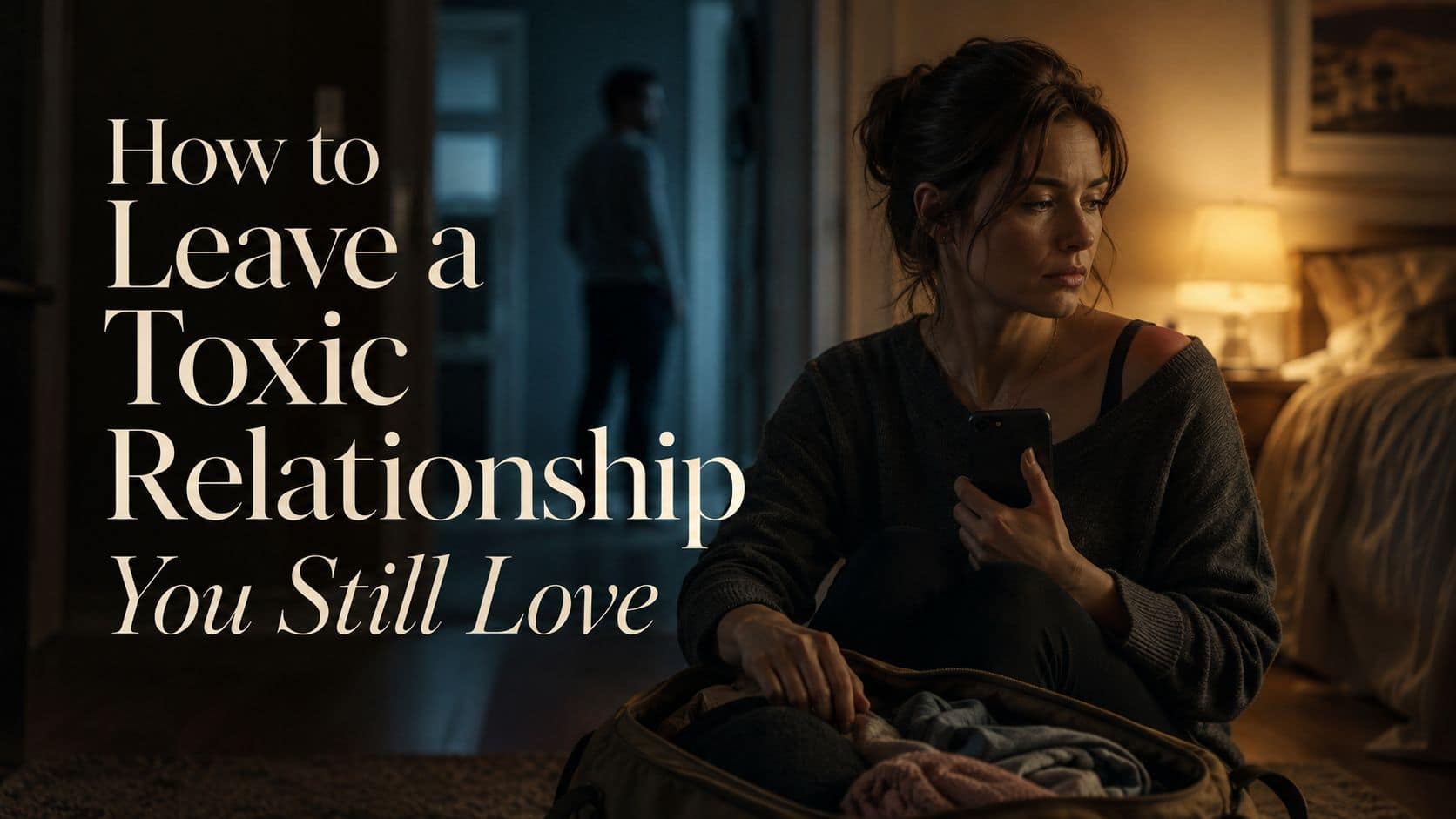
How to leave a toxic relationship when you still love him is the hardest thing to search for, because part of you is hoping the answer is “you don’t have to.”
So let me start by arguing against myself. Because if I don’t, you shouldn’t trust a word of this.
Here’s the weakest part of everything I’m about to tell you.
The word “toxic” gets thrown around like confetti now.
He forgets to text back, suddenly he’s “toxic.” He’s grumpy after work, “toxic.” That cheapens the word.
And it means advice like this lumps together two different things: a guy who is genuinely harming you, and a guy who is just bad at relationships and could maybe learn.
Those are not the same. Pretending they are is dishonest. So I won’t.
The Objections I’d Raise If I Were You

Second problem. This whole piece only hears one side. Yours.
I don’t know what he’s like, what you’re like in a fight, or whether “toxic” is fair or just the story you tell after a bad week.
Relationship advice that only flatters the reader is selling comfort, not truth.
Some couples who feel doomed go to therapy and come out stronger.
That happens. I won’t pretend it doesn’t.
Third, and this one is serious. “Just leave” is the most useless sentence in the English language.
People say it like you’re picking a restaurant. You might share a lease. A bank account. A kid. A dog you’d die for.
You might have nowhere to go and forty dollars till Friday. Telling someone to walk out ignores the actual door, which is often locked by money.
And the fourth thing, the big one.
Leaving can be the most dangerous moment in an abusive relationship, not the safest.
The risk of serious harm often spikes right when someone tries to go.
So any honest guide has to say it plain: do not just bolt without a plan if you feel unsafe. Speed can hurt you here.
So there. That’s the case against me. If you were waiting for me to skip the inconvenient parts, I just handed them to you first.
Now. With all that on the table, here’s what I actually believe, and why I think it holds up.
Loving Him Is Not a Reason to Stay in a Toxic Relationship

You can love someone and still need to leave a toxic relationship. Both true at once. That’s the part nobody prepares you for.
We’re taught love is the finish line. If you love him, you stay, you fight for it, you make it work. Roll credits.
But love isn’t a permission slip for how someone treats you.
You can love a person while that person slowly shrinks you into a smaller, quieter, more anxious version of yourself.
Here’s a small story. A friend of mine, call her Dana, stayed four years past the point she knew.
Why? She kept saying “but I love him” like it settled the argument. It didn’t settle anything.
She loved him and dreaded coming home. Both lived in her at the same time.
The love was real. The dread was also real. The dread was the data.
That’s the reframe. Stop asking “do I still love him.” You probably do, and that question keeps you stuck.
Start asking “who am I becoming in here.” That one’s harder to dodge.
Signs of a Toxic Relationship vs a Hard One

Remember my own objection: “toxic” is overused. Fair. So let’s get specific, because vague is useless.
How Do You Know If a Relationship Is Toxic?
A relationship is toxic when the harm follows a pattern, not a bad day. The clearest sign is broken repair: after a fight, you end up apologizing for being hurt. You edit yourself to keep him calm, you hide things from friends, and you feel relief instead of loneliness when he leaves.
Hard relationships have conflict. Toxic ones have a pattern. The difference is repair.
After a fight, do things get worked out, or do you end up saying sorry for being upset that you got hurt?
That backwards apology is a tell.
A Few Signs of a Toxic Relationship Worth Watching For
- You edit yourself before you speak, running every sentence through a filter so he won’t blow up.
- Your friends have gone quiet about him, or you’ve stopped telling them things.
- You feel relief, not loneliness, when he leaves for a few days.
- The good moments now work like a paycheck for surviving the bad ones.
- You keep a private mental file of evidence to prove to yourself you’re not crazy.
One bad week isn’t a pattern. A year of these is. Be honest about which one you’re looking at.
If it’s genuinely fixable and he’s willing, couples counseling is a real option, and I’d be lying to say otherwise.
But “willing” is the magic word. Someone who refuses to even look at it is answering the question for you.
The Red Flags That Look Like Love
Get the free checklist of the toxic patterns that disguise themselves as chemistry, certainty, and being chosen, with the one question that exposes each one.
Straight to your inbox, along with The Safe Love Reset every Monday. No spam, no shaming, leave anytime.
How to Leave a Toxic Relationship Safely

I said earlier that leaving can be the dangerous part. I meant it.
This gets its own section because it’s where well-meaning advice gets people hurt.
The research is grim. Studies on domestic violence have found that roughly three out of four of these homicides happen after the victim leaves or tries to, and the raised risk can stretch on for up to two years.
So if there’s any physical fear in the picture, any history of him getting violent, controlling your money, or threatening you, do not announce your exit and slam the door.
Quiet planning beats a dramatic exit.
That looks like:
- Setting aside money somewhere he can’t see, even small amounts over time.
- Copying important papers (ID, bank stuff, birth certificates) and stashing them with someone you trust.
- Telling one safe person the real situation so you’re not alone with it.
- Knowing where you’d go before the night you need to go.
If you’re in the US, the National Domestic Violence Hotline is built for exactly this.
Call 1-800-799-7233, text START to 88788, or chat at thehotline.org. It’s free, it’s 24/7, and you don’t have to be in crisis to use it.
They help people think it through. This isn’t drama. It’s a fire drill.
You hope you never need it and you’re glad you did it.
What Leaving a Toxic Relationship Really Looks Like

Forget the clean exit. Nobody throws a suitcase in a car and drives into a sunset feeling great.
Real leaving is messy and back-and-forth and full of nights you almost text him “I made a mistake.”
So plan for the wobble instead of pretending you won’t wobble.
Write down why you’re leaving while you’re clear-headed. Date it.
Because at 2am, missing him, your brain will rewrite history and tell you it wasn’t that bad.
The note is you, sober, talking to you, drowning. Let past-you win that argument.
Go no contact if you safely can. Not because he’s a monster, but because every conversation is a door, and you keep walking back through doors.
You can’t heal a wound you keep reopening to check on it. Mute him. Mute the mutual friends who report back. Protect the quiet.
And expect the grief to feel insane. You’ll grieve a person who hurt you. You’ll miss the version of him that showed up on good days.
That doesn’t mean you’re wrong to go. It means you’re human and you loved someone. Both true. Again.
Why Some People Disagree About Leaving
Let me hold my own feet to the fire one more time, because I promised total honesty and the easy thing would be to coast to the finish.
A smart, caring person could read all this and push back.
They’d say I’m framing love as a trap and leaving as the brave answer, but plenty of relationships go through years that look exactly like my “toxic checklist” and come out the other side after real work.
They’d say I’ve put a thumb on the scale toward exit. They’d be partly right.
They’d also say I can’t see your specific relationship, so who am I to call it. Also right.
Here’s why I land where I land anyway. The cost of leaving a relationship that could’ve been saved is real but recoverable: heartbreak, regret, a hard year.
The cost of staying in one that’s genuinely eating you is your nervous system, your friendships, sometimes your safety, measured in years you don’t get back.
When I weigh a recoverable mistake against an unrecoverable one, I lean toward the recoverable one.
That’s a judgment call. You’re allowed to make a different one. I just want you making it with clear eyes, not fog.
How to Leave a Toxic Relationship: Your First Step

I’m not telling you to leave tonight. I’d be one more person barking “just leave,” and I already trashed that advice.
I’m asking for one honest week.
Watch yourself, not him. Notice who you are in your own house. Write the dated note. Tell one safe person the unedited truth.
If safety’s a factor, make the quiet plan first.
Loving him was never the question.
The question is whether the person you turn into around him is someone you’d wish on your best friend.
If that thought makes your stomach drop, you already know. You’re waiting for permission you don’t actually need.
You can love him and still go. You can grieve him and still be right to leave.
So don’t leave a toxic relationship in one brave leap. Start the honest week tonight, write the note before you sleep, and take it one clear-eyed choice at a time.
Sources:
Blackburn Center: Domestic Violence Homicide, The National Domestic Violence Hotline