
Maya didn’t know she was in a toxic relationship.
That’s the part nobody tells you.
She thought she was just bad at communication.
The Day She Realized Something Was Wrong
It was a Tuesday in March 2021.
Maya was 29, living in a one-bedroom apartment in Atlanta with her boyfriend of three years, Darius.
She had cooked dinner. Jerk chicken, rice, the whole thing.
Darius came home, looked at the pot, and said, “You always make this when you don’t feel like trying.”
Maya laughed it off.
But she noticed her hands were shaking while she washed the dishes.
That happened a lot. Shaking hands. A tight chest before he came home.
Checking the clock to see if she had time to clean up before he walked in the door.
She thought that was just what relationships felt like.
Three Years of “I’m Just Sensitive”

Let’s back up.
Maya and Darius met in 2018 at a mutual friend’s birthday party. He was charming, funny, attentive. He called her twice a day in the first month. She thought that was love.
By month three, those same phone calls became a way to check where she was.
By year one, she’d stopped going to her friends’ events because it wasn’t worth the argument afterward.
By year two, she believed him when he said she was “too emotional.” That her memory of arguments was unreliable.
That she was “doing the most” over things that didn’t matter.
She stopped trusting herself.
That’s the part that did the most damage.
Not the arguments. Not the name calling, which was rare enough that she could almost convince herself it didn’t count.
It was the slow erosion of her own confidence in her perception.
She stopped saying what she thought, because he’d explain why she was wrong.
She stopped making decisions, because every decision she made was eventually criticised.
She started asking permission for things she never would’ve questioned before.
The Jerk Chicken Tuesday

So. Back to March 2021.
After the jerk chicken comment, Maya went to the bathroom and sat on the edge of the tub for about 12 minutes. She didn’t cry. She just sat there.
She thought about the fact that she hadn’t called her best friend Kezia in six weeks. Not because she was busy.
Because she didn’t have anything good to say, and Kezia asked questions Maya didn’t want to answer.
She thought about a promotion she’d turned down four months earlier because it required occasional travel, and she knew what that conversation with Darius would look like.
She thought about how, a year and a half ago, she would’ve eaten her jerk chicken and told him to make his own food if he didn’t like it.
Something shifted that Tuesday. Not dramatically. Not like the movies. It was just a quiet, exhausted thought:
I don’t recognize myself anymore.
She Didn’t Leave Right Away (And That’s Okay)
Maya didn’t pack a bag that night. She didn’t call Kezia. She didn’t do anything dramatic.
She went back to the kitchen. She plated the food. She ate dinner.
But something had been activated. Like a pilot light.
Over the next six weeks, Maya started paying attention differently. She started noticing patterns. Not to build a case against Darius, but because once you start looking, it’s hard to stop.
She noticed she apologised roughly 8 to 10 times a day. She counted once.
For things like: opening the curtains too early, having a conversation with a male coworker she mentioned in passing, and asking a question he thought she should already know the answer to.
She noticed she had a physical anxiety response, increased heart rate, tight shoulders, before every phone call with him when she was out somewhere.
She noticed she’d stopped reading. She used to read a book a week. She hadn’t finished one in over a year. Couldn’t concentrate.
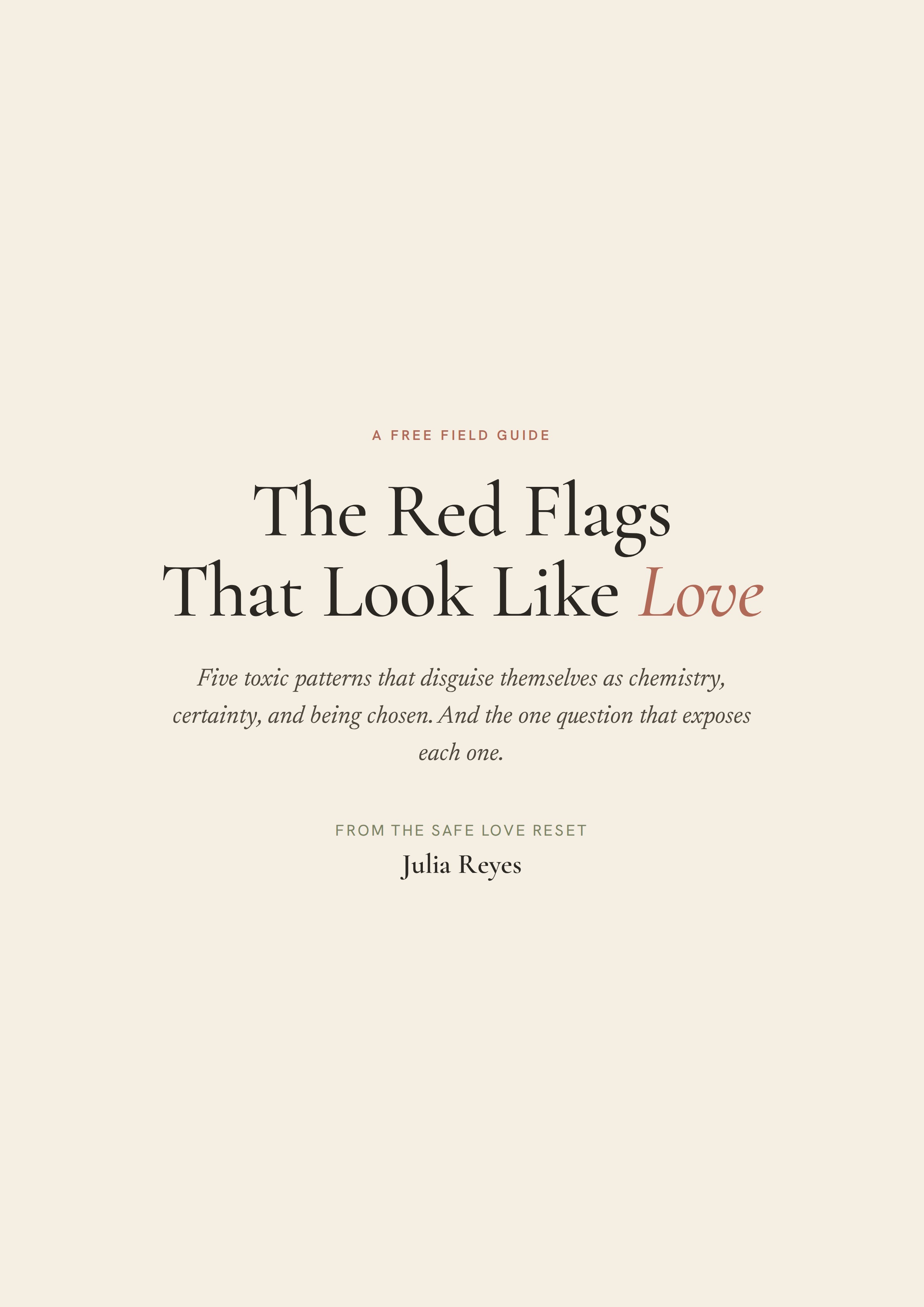
The Red Flags That Look Like Love
Get the free checklist of the toxic patterns that disguise themselves as chemistry, certainty, and being chosen, with the one question that exposes each one.
Straight to your inbox, along with The Safe Love Reset every Monday. No spam, no shaming, leave anytime.
The Conversation That Actually Started Everything

In April 2021, Maya called Kezia.
Not to talk about Darius. She called to catch up. They talked for three hours.
About twenty minutes into the call, Kezia said, “You sound different. You sound like you’re choosing your words carefully.”
Maya said, “I’m just tired.”
Kezia said, “You’ve been tired for two years, Maya.”
That was it.
That was the whole conversation that mattered. Not a lecture. Not an intervention. Just a friend who said the quiet part out loud.
Maya cried in her car for 45 minutes after they hung up.
What Moving On Actually Looked Like

Maya left in June 2021. Not dramatically. She waited until Darius was visiting family for a long weekend, and she moved her essentials to her cousin’s spare room.
She didn’t have a plan. She had a phone full of apartments she’d been quietly Googling for three weeks.
Here’s what the next six months looked like, specifically:
Month one
She slept 11 hours most nights. She said later it felt like her body was paying off a debt. She cried at random moments, not always about Darius, sometimes just from relief. She called Kezia almost every day.
Month two
She started therapy.
Not because she felt ready, but because her cousin sat next to her and helped her find a Black female therapist who took her insurance.
The first session she mostly talked about work. That was fine.
Month three
She started feeling angry. This was new. Through the whole relationship she’d felt sad, anxious, confused. Angry was different.
Her therapist told her the anger meant something was healing. She didn’t fully believe that, but she wrote it down anyway.
Month four
She went back to reading. She finished three books in three weeks.
She cried after finishing the second one, not because it was sad, but because she realized she’d been able to concentrate again.
Month five
She had a moment at a work event where a colleague made a joke, and she fired back with a sharper one, and everybody laughed, and she thought: that used to be me all the time.
Month six
She took the promotion. Different company by then, but same opportunity. She said yes before she could overthink it.
The Red Flags That Look Like Love
Get the free checklist of the toxic patterns that disguise themselves as chemistry, certainty, and being chosen, with the one question that exposes each one.
Straight to your inbox, along with The Safe Love Reset every Monday. No spam, no shaming, leave anytime.
The Thing That Actually Helped Her Move On
People ask what the “thing” was. What the advice was. What the technique was.
It wasn’t one thing.
But if she had to pick the most useful shift, it was this: she stopped trying to figure out if Darius was a bad person.
That question kept her stuck for months. Was he abusive? Was he just insecure? Did he mean to do it? Was some of it her fault?
Her therapist told her something in month three that restructured her entire thinking:
“The impact doesn’t require you to prove the intent.”
She didn’t need a verdict on Darius to know that she felt better without him.
She didn’t need to win an argument about whether what happened was “real” enough to count.
Her hands had stopped shaking. That counted.
What She Knows Now That She Didn’t Know Then
By January 2022, Maya was living in her own apartment, six months into a job she actually liked, back in her friendships, back in her body.
She wrote down, at her therapist’s suggestion, a list of things she now knew:
- Anxiety before your partner comes home is not normal. You can love someone without dreading them.
- Apologizing constantly is a sign something is very wrong.
- When you stop trusting your own memory, that’s not “being emotional.” That’s a response to something someone is doing.
- You don’t need the other person to agree that it was hard for it to have been hard.
- Your friends will still be there. Even if you disappeared for a year.
- You can grieve a relationship and still know leaving was right. Both are true at the same time.
The Part Nobody Talks About

Maya talks about this openly now. She works in HR, and she’s said more than once that she’s the person at work people come to when they’re trying to figure out what’s normal.
She doesn’t tell them to leave. She doesn’t tell them what to do.
She tells them what she wished someone had told her in 2019:
“Pay attention to how you feel in your own body when you know they’re about to come home.”
That’s it. That’s the whole test.
You shouldn’t feel afraid of someone who loves you. You shouldn’t feel like you need to manage someone who’s supposed to be your partner.
If you’re shaking while washing dishes, something needs to change.
If You’re Still Deciding…
You don’t need to have everything figured out to take a first step.
Maya didn’t leave with a plan. She left with a phone full of Zillow listings and her cousin’s spare room key.
She didn’t feel ready. She felt exhausted enough that staying felt harder than going.
That’s enough. That counts.
If you’re reading this and something in you recognised Maya’s Tuesday night bathroom moment, that recognition is information. Your body knows before your brain can put words to it.
You don’t have to call it toxic. You don’t have to label it anything.
You just have to ask yourself one question:
Do I recognise myself anymore?
If the answer takes more than a second, you already know.
If this felt like it was written for someone you know, send it to them.
You don’t need to add a message. Sometimes just forwarding the article is the whole conversation.
And if you’re in it yourself, talking to someone is the first real move. A friend, a therapist, a hotline.
One conversation at a time.